

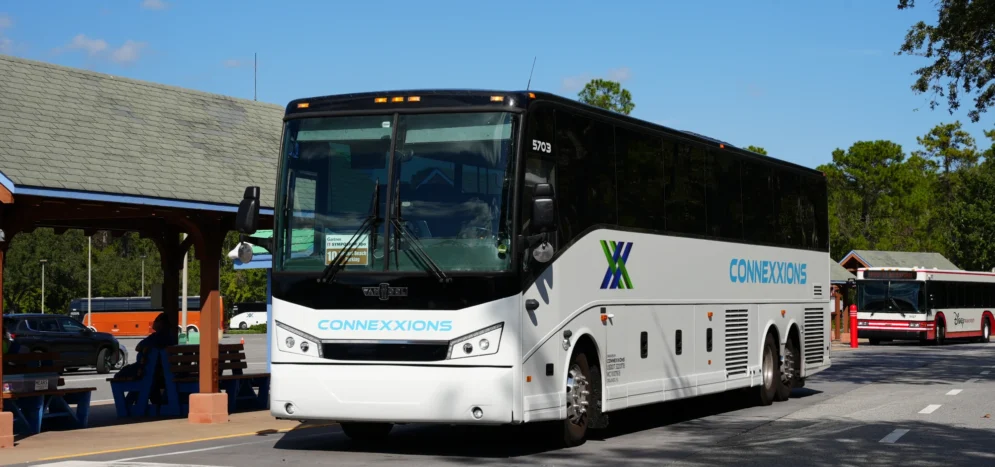
Charter bus vs coach bus is one of the most common questions we get, and the honest answer surprises people: they are the same vehicle. Charter bus, coach bus, motorcoach, school bus, party bus — some of these words mean exactly the same thing, and some mean very different things.
Short answer: “coach bus” and “motorcoach” are the same vehicle. “Charter” is not a vehicle type at all — it describes how you book it: the whole bus is reserved privately for your group, with a professional driver, on your schedule. A school bus and a party bus are genuinely different vehicles built for different jobs.
Here is the whole picture in one table, and then what each one is actually good for.
In this guide
- The five types, side by side
- Charter bus vs coach bus: are they actually different?
- What does “charter” actually mean?
- Why a school bus is the wrong choice for most trips
- Party bus vs. charter bus: they are not competitors
- So which one does your group need?
- Frequently asked questions
The five types, side by side
| Type | Seats | Restroom | Luggage bay | Best for |
|---|---|---|---|---|
| Motorcoach (= coach bus) | 40–56 | Yes | Yes, large | Long distance, multi-day, highway travel, anything over 2 hours |
| Mid-size coach | Up to 40 | Yes | Yes | Mid-sized groups, regional day trips, tight downtown streets |
| School bus | 50–71 | No | No | Short local runs under an hour. Nothing else. |
| Party bus | 15–40 | Sometimes | No | Short entertainment loops where the ride is the event |
| Charter | Not a vehicle — a booking model | Any of the above, reserved privately for your group with a driver | ||

Charter bus vs coach bus: are they actually different?
Yes. They are two names for the same vehicle: a 45-foot highway bus with reclining seats, an onboard restroom, climate control and luggage bays underneath. “Motorcoach” is the industry term. “Coach bus” is what most customers say.
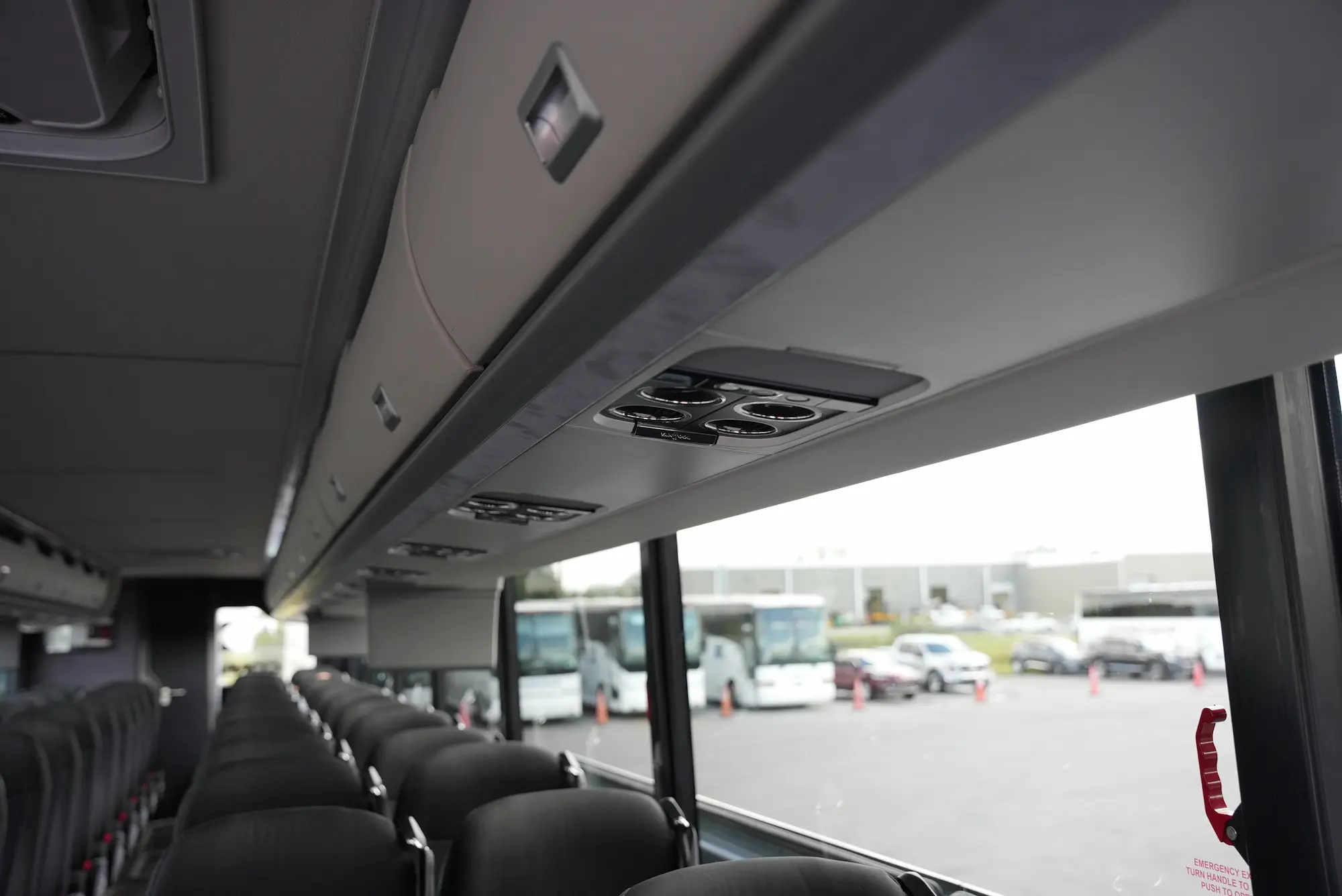
The things that separate a motorcoach from every other bus on this list are all built for distance. The seats recline and have real legroom because people are in them for hours. The luggage goes underneath instead of on laps. There is a restroom because you cannot stop a 50-person group every 90 minutes without wrecking the schedule. And the suspension is designed for highway ride quality, not for stop-and-go city routes.
What does “charter” actually mean?
Chartering a bus means the entire vehicle is reserved for your group alone, with a professional driver, following an itinerary you set. You are not buying seats on a scheduled route — you are booking the whole bus and the driver’s time.
That is the difference between a charter and Greyhound or FlixBus. Those are line-run services: fixed routes, fixed stops, you buy a seat. A charter goes where you say, when you say, and stops where you want it to stop.
It also means the bill works differently. You are paying for the driver’s whole day, not per passenger. A five-hour local charter costs the same whether you put 12 people on it or 52 — which is why the cost per person drops sharply as the group gets bigger.
Why a school bus is the wrong choice for most trips
School buses are excellent at exactly one thing: moving a lot of people a short distance, cheaply. Beyond about an hour, the problems stack up fast.
- No restroom. Every stop costs 20 minutes with a large group.
- No luggage space. Bags ride on laps and in the aisle, which is both uncomfortable and a safety issue.
- Bench seats, no recline, no belts on most. Fine for 20 minutes. Rough for three hours.
- No climate control worth the name in a Florida summer or a Tennessee January.
- Slower. Many are governed to a lower top speed, which adds real time on a highway run.
If your trip is a 30-minute hop across town, a school bus is a reasonable, economical choice. If it is a field trip to another city, it is going to be a long day for everyone.
Party bus vs. charter bus: they are not competitors
A party bus is built so the interior is the destination — perimeter seating, sound system, lighting, often a bar area. It is designed for a two or three hour loop where the point is being on the bus.
A charter motorcoach is built to get a group somewhere comfortably. Forward-facing reclining seats, luggage underneath, a restroom.
The mistake we see most often is booking a party bus for a wedding where guests actually need to be moved between three locations over eight hours. The seating is wrong for it, capacity is lower than people expect, and there is nowhere to put anything. Book the party bus when the ride is the event. Book the coach when the ride is transportation.
So which one does your group need?
| Your situation | Book this |
|---|---|
| 40+ people, trip over 2 hours, luggage involved | Full-size motorcoach |
| 20–40 people, regional day trip, downtown stops | Mid-size coach |
| Wedding guests across multiple venues, all day | Motorcoach on a shuttle loop |
| Sports team with equipment | Motorcoach — you need the luggage bays |
| Short local school run, under an hour | School bus |
| Bachelorette night out, three stops, three hours | Party bus |
| Corporate group that needs to work en route | Motorcoach with WiFi and outlets |
Whichever type you end up booking, check the operator before you pay a deposit. Every company that runs commercial passenger vehicles across state lines has a USDOT number, and their safety record is public — you can look up any carrier for free on the FMCSA’s SAFER Company Snapshot. Ours is USDOT 3220178.
Frequently asked questions
Is a motorcoach the same as a charter bus?
A motorcoach is the vehicle. A charter is the booking arrangement. Most charter buses are motorcoaches, so in everyday use people treat the terms as interchangeable — but strictly speaking you can charter a minibus or a school bus too.
Charter bus vs coach bus: what is the actual difference?
None, in practice. In the charter bus vs coach bus comparison, both words point at the same 45-foot motorcoach — “coach bus” describes the vehicle type, and “charter bus” describes that same vehicle booked privately for one group.
Do all charter buses have bathrooms?
Full-size and mid-size motorcoaches do. Minibuses, sprinter vans and school buses generally do not. Always confirm before you book — it changes how you plan the stops.
How many people fit on a charter bus?
Up to 56 on a full-size motorcoach and up to 40 on a mid-size coach. Note that seat count and comfortable capacity are not the same thing once luggage is involved.
Is a charter bus cheaper than several vans?
For groups over about 25, almost always — and you avoid the bigger hidden cost of coordinating multiple vehicles, multiple drivers and multiple parking situations.
Can you charter a school bus?
Yes, and for short local trips it is the economical option. For anything over an hour, the lack of a restroom and luggage space usually outweighs the savings.
What is a coach trip?
In American usage it usually means a multi-day tour by motorcoach. In British usage, “coach” alone just means a highway bus.
Which type has the most legroom?
A full-size motorcoach, by a wide margin. That is the vehicle designed for people to sit in for six hours.
Still not sure which one fits? Tell us the group size, the distance and how long the day runs, and we will tell you which vehicle we would send — even if it is a smaller one than you asked about.
Related reading: What is a charter bus? · How many seats are on a charter bus · What size bus do you need
Planning a group trip? Send us the date, the group size and where you’re going. You’ll have a real number back in two to four hours — no call center, no bidding war.